Vibe Sea Ghost 110 Review: Rudder, Weight and Fit
Disclosure: this page contains Amazon affiliate links. As an Amazon Associate I earn from qualifying purchases, at no extra cost to you. How we choose and what we don’t do.
This Vibe Sea Ghost 110 review is written for the person deciding between a rudder-equipped fishing kayak and a cheaper, simpler boat. The short version: the Sea Ghost 110 gives you a genuine toe-controlled rudder, a transducer port and a seat you can sit in for six hours — and it asks for 84 pounds of rigged weight in return. That last number decides whether this kayak is a joy or a problem, and almost nobody talks about it before you buy.
Quick verdict
- Buy it if you fish open lakes, bays or slow coastal water where wind pushes you around, and you can load a heavy boat with a cart or a second pair of hands.
- Skip it if you carry your kayak alone to the roof of a tall SUV, or you fish small creeks where an 11’6″ hull is constantly bumping banks.
- The reason to pay up: the rudder. It is the difference between fighting a crosswind all afternoon and forgetting the wind exists.
- The thing you will buy next: a cart. Not optional at this weight.
What the Sea Ghost 110 actually is
It is a sit-on-top fishing kayak in the middle of the market: above the big-box boats you see stacked outside hardware stores in spring, well below the pedal-drive machines. Vibe sells it rigged rather than bare — rudder included, not a paid add-on, which is unusual at this level and is most of the argument for the boat.
Vibe Sea Ghost 110
| Length / beam | 11’6″ long, 33″ wide — long enough to track, wide enough to feel planted |
| Dry weight | About 62 lb hull only; roughly 84 lb once the seat, rudder and hardware are on it |
| Capacity | 425 lb total — angler, gear, catch, everything |
| Steering | Toe-controlled rudder, included as standard |
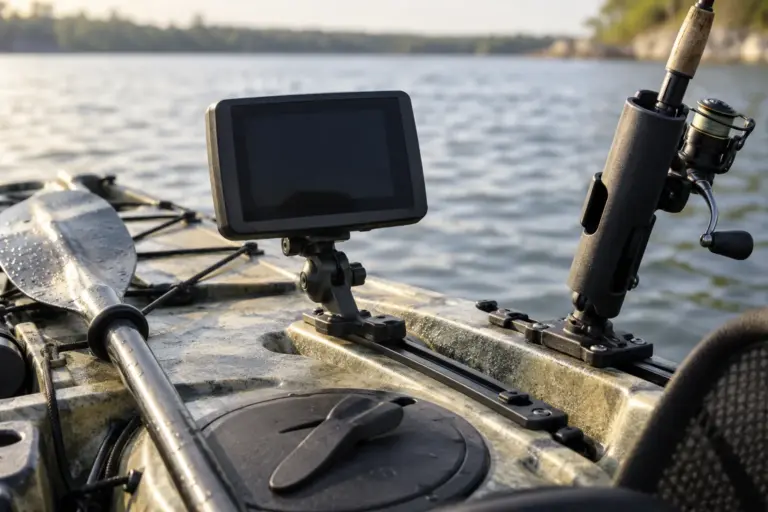
| Electronics | Transducer scupper through the hull, so a fish finder installs without drilling |
| Rod storage | Flush-mounted holders plus gear tracks for adding your own |
| Seat | Elevated quick-dry frame seat with two height positions |
The 33-inch beam is the stability story. It is wide enough that most anglers can stand and cast in flat water after a session or two of practice, and wide enough that leaning over the side to net a fish does not feel like a gamble. It is also wide enough to cost you speed — this is not a boat you race across a lake in.
The rudder is the whole point
A rudder on a fishing kayak is not about turning. It is about holding a line while your hands are busy. Without one, a breeze on your beam means a correction stroke every few seconds — and every correction stroke is a cast you did not make. With a toe-controlled rudder you nudge a pedal, the boat holds, and you keep fishing. On a windy bay, this is the single feature that changes how many hours you can stay out.
Two honest caveats. First, rudder cables and the pivot need a freshwater rinse after every salt trip, or they seize — this is a maintenance job you are signing up for. Second, a rudder does not replace an anchor: if you want to hold position over structure, you still need a way to stop, and on a kayak that means an anchor trolley or a stake-out pole.
Dry weight: the spec everyone ignores
Here is the pattern we see constantly. Someone buys a well-specced 11-foot fishing kayak, uses it four times in the first summer, then twice the next year, then sells it. The boat was fine. The loading was not. Eighty-four pounds is manageable sliding onto a trailer, awkward onto a low sedan roof, and genuinely risky lifting overhead onto a tall SUV alone.
Before you buy, do the honest arithmetic: can you deadlift 84 lb from the ground to shoulder height, in a parking lot, at 5 a.m., after a day of fishing? If the answer is “maybe,” budget for a kayak cart to get it from the car to the water, and a J-cradle setup that lets you load from the rear of the vehicle rather than lifting straight up.
Before the first trip — this part is not optional
- Wear the PFD, do not stow it. Most people who drown from a kayak had a life jacket aboard. It was behind the seat. Wear it from launch to landing — see our PFD picks that actually fit an angler.
- Cold water kills faster than cold air. Below roughly 15 °C / 59 °F, cold shock hits in the first minute and your hands stop working within about ten. Remember 1-10-1: one minute to get your breathing under control, ten minutes of useful movement, one hour before hypothermia takes you. Plan your self-rescue around ten minutes, not an hour.
- After sunset you need a white 360° light. In US waters a kayak underway at night must show an all-round white light visible to other boats. A proper mast-mounted 360° light is the legal and practical answer; a headlamp is neither.
- Carry a whistle, a bilge pump and a paddle leash, and practise climbing back on in shallow water before your first real trip. Re-entry is a skill, not an instinct.
- Never anchor from the side in current. A kayak anchored off its beam in moving water flips — that is precisely why anchor trolleys exist, to move the anchor point to the bow or stern.
- Tell someone where you launch and when you will be back. Every time, including the short trips.
Rigging it: what to add, and in what order
The Sea Ghost arrives usable. It does not arrive finished. The order that makes sense for most anglers:
- Safety first, genuinely. A worn fishing-cut PFD with front pockets, a 360° navigation light if you will ever be out at dusk, and a pump.
- A fish finder in the transducer scupper. The hull is built for it, so this is a screwdriver job rather than a drilling job — see our fish finder picks and setup notes, or start with a simple entry-level unit.
- Track-mounted rod holders. The flush mounts handle trolling; adjustable track-mount holders are what you want for working rods. More on choosing between flush and track mounts.
- An anchor trolley kit once you start fishing structure rather than drifting.
- Dry storage. A roll-top dry bag for phone, keys and a spare layer. The tank well holds a crate; the hatches are not submarine-proof.
- A paddle that is not the one in the box. If the boat comes without one, or with a heavy aluminium stick, a lighter angler-length paddle is the cheapest comfort upgrade you will ever make. See how to pick a length.
Who should buy something else
| If this is you | Look at this instead | Why |
|---|---|---|
| You load alone onto a tall vehicle | A lighter beginner boat | A 44-52 lb hull is the difference between going out and not going out |
| You fish small rivers and creeks | A shorter sit-on-top | 11’6″ with a rudder is a liability in tight bends and shallow rock |
| You want the most boat for the least money | Our under-$1000 breakdown | The rudder is worth paying for, but only if wind is actually your problem |
| You are not sure sit-on-top is right at all | Sit-on-top explained | Self-bailing hulls matter more than any single model choice |
Questions people actually ask
Can you stand up and fish from a Sea Ghost 110?
Most anglers can, in flat water, once they have practised. The 33-inch beam and flat standing area make it realistic. In chop, or with a strong beam wind, sitting is faster and safer — and standing in cold water without a worn PFD is how a good day ends badly.
Is the rudder worth it over a cheaper kayak?
If you fish open water with wind, yes, and it is not close. If you fish sheltered ponds and small lakes, you are paying for a system you will rarely deploy and will still have to rinse and maintain.
How heavy is the Sea Ghost 110 really?
Roughly 62 lb as a bare hull and about 84 lb rigged as it is normally sold. Quoted hull weights across the industry exclude seat and hardware, which is why kayaks always feel heavier than the spec sheet promised.
What is the weight capacity, and how much can I actually load?
425 lb is the stated maximum. Treat about 70-75% of any kayak’s rated capacity as the comfortable working load — beyond that the hull sits low, scuppers start letting water in, and handling degrades.
Do I need a cart?
At this weight, effectively yes, unless you launch from a trailer or always fish with a partner. Dragging a loaded hull across gravel to save the cost of a cart is how you wear a flat spot into the keel.
- Best sit-on-top fishing kayaks — how this hull compares to the rest of the category
- Best kayak carts — the accessory this boat genuinely requires
- Best kayak fish finders — what to put in that transducer scupper
- Best PFDs for kayak fishing — the one item you wear, not stow
- Kayak seat upgrades — and the free fixes to try first
- Lifetime Tamarack Angler 100 review — the light, cheap alternative
- Pelican Sentinel 100X Angler review — the one you can load alone
How we reviewed this (updated 16 October 2026): this page is based on manufacturer specifications, listing details and public buyer feedback. We have not hands-on tested this product.