How to Launch a Kayak From a Beach: Surf Entry Basics
Launching from a ramp or a calm pond bank is mostly a non-event. Launching from a beach, with any surf at all, is where a lot of first-timers get an unplanned swim in the first thirty seconds — not because it’s genuinely hard, but because nobody explained that timing matters more than paddling hard.
This covers small-to-moderate surf on a fishing kayak, not a storm swell. If waves are breaking in sets over about waist height, that’s a different, more advanced skill — fish somewhere else that day.
Before you wade in
- PFD on, on the sand, before you’re in the water. Waves and current at a beach entry make the ten seconds between “I should put this on” and “I need this now” shorter than you think.
- Watch the water for a few minutes before you launch. Count the wave sets — most beach breaks come in groups with a calmer lull between them, and that lull is your window.
- Know the rip current signs for your beach if it has any: a channel of choppier or discoloured water moving away from shore. Never fight a rip head-on if you end up in one — swim or paddle parallel to shore first.
- Cold water rules still apply. A beach launch often means more time actually in the water than a ramp does — below roughly 15 °C / 59 °F, remember 1-10-1.
Why a sit-on-top makes this dramatically easier
A sit-inside kayak that swamps in the surf zone fills with water and becomes very hard to manage. A sit-on-top drains through its scupper holes and stays paddleable even half-full — which is most of why fishing kayaks launched from open beaches are almost always sit-on-tops. If beach launches are a regular part of your fishing, that’s a real factor in sit-on-top vs sit-inside, not just a minor preference.
The launch, step by step
- Rig everything on the sand first. Rods stowed, crate secured, nothing loose. You will not be doing this once you’re past the shorebreak.
- Watch for the lull between sets. Time your push for the gap after a set has passed, not into an incoming wave.
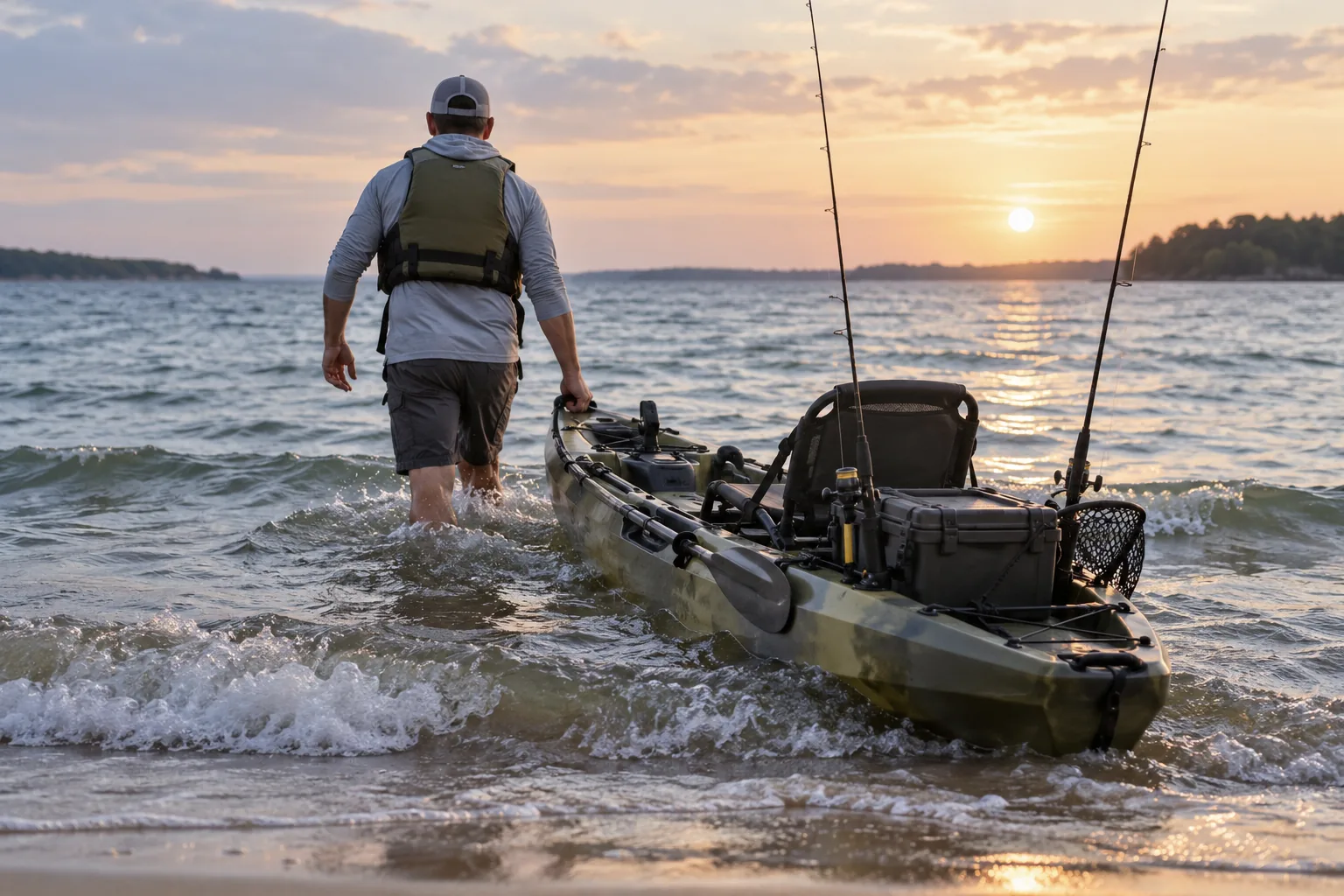
- Push out walking, straddling the kayak, facing forward. Walk it out past the point where waves are breaking before you climb aboard — climbing on in the shorebreak is how people get rolled.
- Paddle hard and steady through the impact zone. Committed, continuous strokes get you through faster than a hesitant approach — hesitation is what lets a wave catch you side-on.
- Take waves bow-on, never sideways. A wave hitting the side of the hull is what flips kayaks in surf; keep the nose pointed at incoming water.
- Once you’re past where waves are breaking, you’re through. Turn and check your position before you start fishing.
Landing is the part people forget to plan
Coming back in has the same rules in reverse: watch the sets from offshore, time your run for a lull, and stay bow-on or stern-on to the waves, never broadside. Paddle firmly all the way to the sand — slowing down in the shorebreak is when a following wave catches you from behind and pushes the stern around.
- Choose your landing spot before you commit, the same way you’d choose a landing zone from the air — clear of rocks, other swimmers, and steep drop-offs.
- Get out fast once you touch sand. A kayak lingering in the shorebreak gets rolled by the next wave while you’re still half in it.
- Pull the boat clear of the water line immediately — an unattended kayak in a rising shorebreak can be gone, or damaged against rocks, in under a minute.
Reading a beach before you trust it
Not every beach is a fair beginner launch. A gently sloping, sandy beach with small, regular waves and no visible rip current is the forgiving version. A steep beach with a hard shorebreak, rocks, or a known rip is not the place to learn this — go somewhere calmer first and build the skill before you take it to harder water.
Frequently asked questions
What size waves are safe for a kayak beach launch?
As a rough guide for a beginner, small and regular waves under about knee-to-waist height with a visible lull between sets. Anything breaking consistently higher than that, or with no calm gap, is a different skill level — pick a calmer beach or a ramp instead.
Should I sit or stand while launching through surf?
Walk the kayak out straddling it, then climb aboard once you’re past the breaking waves — not before. Trying to sit and paddle from the very edge of the water is how people get caught by the first wave.
What’s the biggest mistake beginners make launching from a beach?
Hesitating in the impact zone. Committed, continuous paddling through the breaking waves gets you clear faster than cautious strokes, and caution here is what lets a wave turn you sideways.
Do I need a sit-on-top kayak to launch from a beach?
Not strictly, but it helps enormously — a sit-on-top drains through its scupper holes and stays manageable even if it takes water, where a swamped sit-inside becomes very heavy and hard to control.
What if I see a rip current where I want to launch?
Choose a different spot. If you’re ever caught in one, don’t fight it directly — paddle or swim parallel to the shore until you’re out of the current, then head in.
A beach launch is a skill, not a gamble, and it gets boring — in the good way — after the first dozen times you time it properly.